
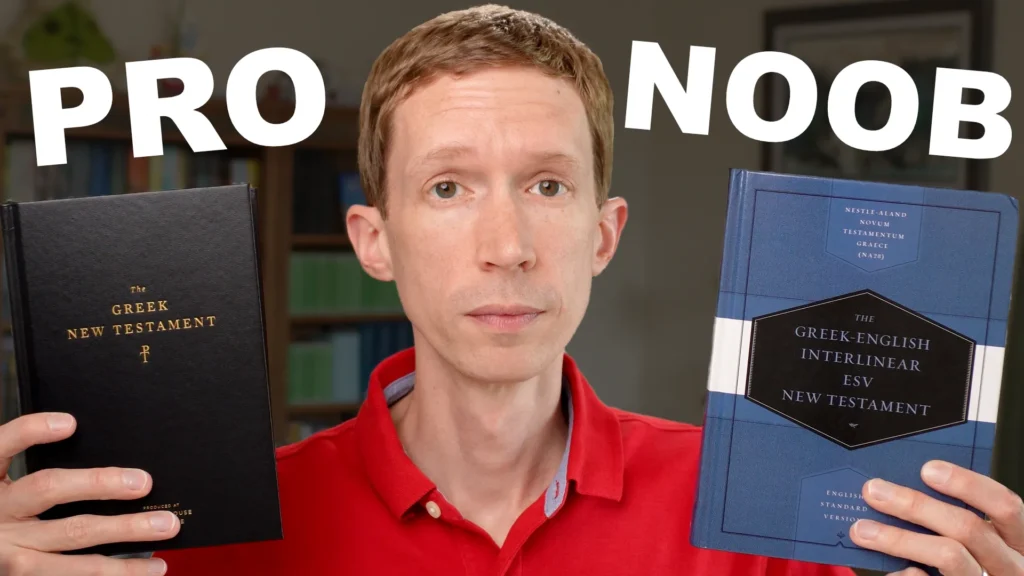
As a beginning Greek student, I struggled to make the transition into reading real Koine Greek texts. My grammar textbook had short snippets from the New Testament to illustrate grammar points. However, every time I picked up a Greek New Testament, I quickly gave up feeling discouraged. It was so far beyond my level that I worried I’d never get there.
I wrote this post to help others avoid that early feeling of discouragement. Because what I discovered over time is a simple tiered system for reading the Greek New Testament. As long as you can recognize the Greek letters and know how to pronounce them, you can jump onto the lowest rung (Level 1) of this ladder.This 4-Level ladder allows you to enter a reading flow state even as an absolute beginner!
Which Greek New Testament fits my level?
Here are the four levels, along with the Greek New Testament appropriate for each level. I have personally spent at least 20 hours handling and reading every recommended Bible on this list.
| Skill Level | Bible Type | Recommended? | Weight | Price (7/20/2026) | Product Link (Affiliate) |
|---|---|---|---|---|---|
| Level 1 | Interlinear | ✅ | 2.2 pounds | $43 | Amazon |
| Level 2 | Greek-English Parallel | ✅ | 1.9 pounds | $47 | Amazon |
| Level 3 | Reader’s Edition | ✅ | 2.6 pounds | $47 | Amazon |
| Annotating Edition | ❌ | 3.6 pounds | $47 | Amazon | |
| Level 4 | Greek Only | ✅ | 1.5 pounds | $28 | Amazon |
| Greek with Dictionary | ❌ | ??? (I don’t own one) | $45 | Amazon |
Spending lots of time in a Level 1 flow state is what allows you to transition into Level 2. Spending lots of time in a Level 2 flow state allows you to move to Level 3, and so on. Each time you move up a level, your flow state will disappear. It will be replaced by the excitement and challenge of pushing yourself into uncomfortable (but still manageable) territory. Over time, as you persevere in the new level, you will naturally begin to enter the new flow state. At first this will happen in fits and starts, but eventually it will be easy and normal. The new flow state will feel amazing at first, but eventually it becomes so easy that you will get bored. That is your signal to move up to the next level.
(There are actually 7 Levels, but let’s forget about Levels 5-7 for now. Levels 5-7 take you beyond the Greek New Testament into the broader corpus of Koine Greek literature.)
High Quality Editions
All of these are high-quality Greek New Testaments. Both the physical design (covers, binding, page thickness) and interior design (fonts, layouts) are accurate and
Smyth-Sewn Binding
All the Greek New Testaments discussed in this review are Smyth-sewn. So you’re not just getting a block of glue to attach the pages to the cover. These are well-made books and should last a long time. The Tyndale house editions (Levels 2-4) also include a ribbon bookmark. The Crossway Interlinear (Level 1) does not have the ribbon bookmark, but it’s still Smyth-sewn.
Page Thickness
Each of these Bibles also has fairly thick, high quality pages. Bibles that contain both the Old and New Testaments have super-thin pages, but you don’t often see that with a Greek New Testament.The Old Testament is three times longer than the New Testament. So even if a Greek New Testament includes an English translation (as in Levels 1 and 2) the total number of words is still only 50% of what’s contained in a full Bible with Old and New Testaments. This allows publishers to use heavier, higher-quality pages.
Greek Font
All of these New Testaments use the Adobe Text Greek font. This is a proprietary font, but it is very close to Gentium Plus, my personal favorite Greek font. Gentium Plus is freely available for anyone to use and download. Here is what Gentium Plus looks like for every Greek letter.
α β γ δ ε ζ η θ ι κ λ μ ν ξ ο π ρ σ τ υ φ χ ψ ω
Α Β Γ Δ Ε Ζ Η Θ Ι Κ Λ Μ Ν Ξ Ο Π Ρ Σ Τ Υ Φ Χ Ψ Ω
In my opinion, the few differences between Adobe Greek and Gentium Plus are negligible. For example, zeta (ζ) is slightly more ornate in Adobe Greek, while iota (ι) is slightly more ornate in Gentium Plus. But many other letters are virtually indistinguishable. Both of these fonts are elegant without being distracting, exactly what you want for long reading sessions.
For more on fonts and font sizes, including photos of page layouts for each of my recommended Greek New Testaments, check out my video review below.
Video Review (Compares 6 Greek Bibles)
Video Transcript
[00:00:00] Which Greek New Testament should you buy? It really depends on your current skill level. These are my recommendations starting with complete beginners. I’ve got them divided up into four different levels from beginner to advanced, so you can skip at any time by going down to the video description, you can skip [00:00:20] forward to whichever level you think you’re at.
Level 1: Greek Interlinear
So let’s start with absolute beginners. For you, I would recommend a Greek Interlinear. It’s really based on the Greek text, but underneath each Greek word, it has the corresponding English, a very simple translation or gloss of the English [00:00:40] meaning.
This is a great starting place because you’re gonna get bored with grammar, and you’re gonna want to start to get into real Greek texts, right? So this is a great way to do it.
As you read it, your eye is still gonna be able to see that English definition right under the Greek word. And this, it’s almost [00:01:00] like watching a video, you know, in a foreign language, but it has subtitles or captions in your native language, and that allows you to start hearing the sounds and getting a sense of the word order of your target language, while still understanding the meaning using the subtitles, or [00:01:20] in this case, English words underneath each Greek word. So this is the edition I used when I was first learning Greek.
This has the English ESV text in small print on the side of each page. Sometimes you’re gonna come to sections that you can’t understand. Even with those English notes [00:01:40] under each word, you’re not gonna understand it and you’re gonna wanna see the English meaning of the entire sentence or the entire verse all at once. And the great thing about this edition is it provides that on every single page.
So if you’re an absolute beginner, this is the one I would recommend. Uh, this is what I’m calling level one. [00:02:00] So the link to this book is in the description down below, just like all the others.
Readable Greek Font
I just wanna pause before we go to level two and mention a few things that all these books have in common, all these Bibles have in common. When I started buying Greek Bibles, one of the main things I cared about was the font.
I wanted a font that looked [00:02:20] good and at the same time wasn’t distracting. I also wanted a font size that was not too small. I mean, when you’re a learner and you’re just, especially when you’re a beginner and you’re just getting started with letter recognition and word recognition, you don’t want to be tripped up by a bad font.
And all the Bibles I’m gonna [00:02:40] talk about today have a good font. Actually, the font looks identical amongst all these, whether it’s um, whether it’s this edition, this Interlinear published by Crossway or the other Bibles I’m gonna show you are published by Tyndale House. So here’s one of the Tyndale House editions.[00:03:00]
The font in both of these and all the others I’ll describe looks very similar to, to me, it looks identical, I can’t really tell the difference. So I think they’re using the same font, which is Adobe Greek is what I read online.
They also advertise slightly different font sizes. So some of these Bibles on their Amazon listings [00:03:20] say, uh, one of them go is 10.5 font. And I think the smallest one goes down to 9. Now, when I am reading all of these that I’m gonna show you, I cannot tell the difference in font size. So maybe, maybe one of them is using a nine and one of them is using a [00:03:40] 10.5, but to me the difference is indistinguishable.
Level 2: Greek-English Parallel
Okay, so let’s move on to level two. Once, once the Interlinear reading starts to get a little too easy to you, you feel like, okay, I need more of a challenge, then you can move up to something like this. This is a Greek English New Testament, [00:04:00] uh, from this is the Tyndale House Edition. So this also has ESV and Greek on facing pages.
Um, all the Tyndale House bibles I’m describing today come with this slip cover so you can, you can kind of leave this slip case on your bookshelf, take out whichever Bible you’re [00:04:20] using at the time. It makes it look a little nicer keeps it clean, keeps it dust free. So I like that.
So for level two, once you open this up, you’re gonna see like on the left hand page, it’s gonna give you the Greek text on the right hand page it’s going to give you the ESV translation, so that’s [00:04:40] really helpful. You can just stick with the Greek as long as it’s making sense to you. But once you hit some spots that you’re not sure about, you can just flip over to the English translation.
It’s nice to do that verse by verse. I normally don’t like verse numbers in Bibles. I think it’s kind of cluttered. I mean, if you’re cross-referencing, it’s [00:05:00] useful, but if I’m just sitting down to read, I’d rather not have the clutter of verse numbers. But when you’re at level two and you’re using Greek and English on facing pages, those verse numbers are really handy.
You know, you get stuck on John chapter five, verse four in Greek, and you can easily just look over to the other [00:05:20] page, find English, John chapter five, verse four, and read the verse in English, then go back to Greek. And so those, those verse numbers really help you when you’re bouncing back and forth between left hand and right hand pages to understand the meaning.
This one is a little bit lighter than the Level one Bible that [00:05:40] I recommend. This is 1.9 pounds, so it’s a little bit easier to hold up and read over long time periods, which is nice.
Now, once again, at some point when you’re reading at level two, it’s gonna start to become too easy and you’re gonna wish that you did not have to keep having that English [00:06:00] translation on the side.
There’re gonna be, things happen like you’re reading a Greek verse and it all makes sense except for one word, and you’re like, what is that word? And you can’t really understand it from the context. What you really need is just a quick definition. But what you have to do is bounce over to the English side, right, and look at the whole verse and [00:06:20] figure out which word matches to that one. And it’s just, it, it gets kind of clunky at some point. Okay? And so when you hit that point, you’re ready to move up to level three.
Level 3: Greek Reader’s Edition
So the level three Bible that I use that I like is again by Tyndale House, and this is called a [00:06:40] Reader’s Edition, Greek New Testament. Now for this one, both left and right hand pages have the Greek text, but the bottom, so the bottom of each page has some notes. So it will give you a short gloss or definition for uncommon words. Those words that appear less than [00:07:00] 25 times will be defined for you at the bottom of the page. So you’re, you’re reading entirely in Greek, but when you hit a tricky word, you’re just gonna bounce down to the bottom of the page, find that word and find the definition and, okay, that makes sense.
There are some books where I still use [00:07:20] this for reading, where I’m basically still at level three. So that would be like, Acts and Hebrews are probably probably the main ones. Maybe some parts of Romans are still tough for me to read without those, those footnotes.
But that’s worth, that’s worth mentioning [00:07:40] also, you’re, it’s not like you’re entirely at one stuck level for the entire Greek New Testament because the Greek New Testament has books by many different authors, right.
Their own fluency with Greek was very different. If you compare John to [00:08:00] Luke, the difference is huge. You could easily be reading John at level four, but still reading Luke at level two or definitely level three, and that’s kind of where I’m at right now. So that’s worth keeping in mind. Depending on what book you’re reading, you may need two different Greek New [00:08:20] Testaments. So that you can switch it out between harder and easier books.
Guided Annotating Edition (Not Recommended)
So I have one other book at level three that I want to talk about because I tried, I tried this out for a while. Some people may find a use for it, but this is massive.
So this is, let’s see, 3.6 pounds. The previous [00:08:40] one, the straight Reader’s Edition. Which is just the level three book is 2.6 pounds, so it’s starting to get a little bit heavy, but this one at 3.6 pounds is definitely not the kind of book that you want to just pick up and read. Um, this is called the Guided Annotating Edition.
If you’re using this, you’re [00:09:00] mostly gonna be setting it down on a flat surface and you’re gonna be making notes in it. So two possible uses for this edition would be if you want to write out the New Testament yourself. It has extra space between each line of text so that you can copy the text yourself, and that could be a decent way [00:09:20] to learn.
I’ve tried this out for doing like an in-depth bible study on one book where I’m just going through beginning to end making notes in the text. I’m marking off words that I want to study in more depth. Maybe there’s like a quote from the Old Testament, so I’m kind of bracketing that quote. And [00:09:40] then with the idea to go and look it up later in the Septuagint, in the Greek Old Testament. This could be useful for some people, I find it has some significant flaws though, so I don’t necessarily recommend this.
I think for a Bible that you’re going to write in the pages like it, the intention is that you’re [00:10:00] writing in it right with a pen, there’s too much bleed through. The pages should have been thicker for this edition, and I’m sure they just, you know, they wanted to keep the cost down and they wanted to keep the weight down.
One other feature it has that none of the others have is these chapter, or these book introductions. So as [00:10:20] different New Testament scholars who wrote an introduction for each book and they talk about some of the typical language that the author uses, you know, the vocabulary they use. Those introductions are not bad, but I just, I don’t find them to be that helpful. And they definitely don’t outweigh the flaws in this edition [00:10:40] that the, the main flaw being the pages should have been thicker. I mean, that’s it. The pages should have been thicker.
Level 4: Greek Only
So now let’s move to level four. Um, once again, this is, a Tyndale House and that’s what I use. Once you’re at level four and you’re just having the Greek New Testament text on each page [00:11:00] without English helps, you’re gonna have more op, more options or opening up to you at that point. Um, so we’ll talk about those in a minute.
This basically just has the Greek text and then the footnotes for this edition is giving you variants. So there’s some kind of scribal variation there as the text was transmitted over [00:11:20] time. And most of those variations are very small. This is gonna give you the variants at the bottom of the page so you can see for any given verse, were there significant variants or not. And if there were not, then you know, okay, like that verse is really solid in certain, in terms of the textual [00:11:40] transmission.
That’s the kind of thing you don’t care about when you’re learning Greek. I mean, you shouldn’t spend a ton of time on that because those notes aren’t even gonna make much sense to you unless you’re able to read fluently. This video is not really intended for someone who’s you know, at that level where they’re a very, very advanced [00:12:00] student or you know, even a scholar. But at that point you start talking about, well, instead of Tyndale House, do I want to use like the Nestle-Aland text, which is the more comprehensive, critical edition that has, you know, more notes and more variants in it, and it has a slightly very slightly [00:12:20] different version of the main text compared to Tyndale House. So I won’t go deeply into those, those matters here.
One nice thing about this, once you’re at level four is this is only 1.5 pounds because you don’t need all those extra notes and English words on the page. You’re, you’re basically just getting the Greek. [00:12:40] So they can get, they can get the size quite a bit smaller, even at basically the same font size. So 1.5 pounds. This is really easy to just sit and read. The price is also cheaper for this, so this is $28.
But if you’re a beginning student, don’t start here [00:13:00] because it’s not gonna make any sense. You gotta work it out, work your way up from level one to level two, to level three, to level four. And then once you’re here, you know you’ll be, it’ll be smooth sailing and you can easily pick this up and read it, take it with you.
Greek with Dictionary (Not Recommended)
Now, there’s one other book at level four I wanna mention. I don’t have a [00:13:20] copy of this one because I don’t really see the use for it myself. It’s basically this level four Greek New Testament, but thicker and the extra thickness, the extra pages. I think it’s like 180 extra pages, which adds about 33% to the page count on [00:13:40] this, is a dictionary. So I don’t, if you’re reading at level four, you don’t need a dictionary at that point. So why have the extra bulk on this book? I don’t understand why they make that edition.
Conclusion: How to Learn
If you’re really a beginner and you’re, [00:14:00] if you’re at level one or level two, you don’t wanna have this with a dictionary because you’re gonna be turning to that dictionary every single word, almost every single word. You’re gonna be flipping back to the dictionary, looking it up, finding the definition, and then returning to the main text. And that’s, that’s just a terrible way to learn. [00:14:20] There’s no way there’s, there’s no way anyone should ever try to learn that way. Maybe a hundred years ago when there were not as many options available, maybe then it sort of made sense to learn that way.
But now when you have all these options of different editions of the Greek text that are more [00:14:40] tuned to your level, there’s no reason to look up every word in a dictionary. You know, that’s really gonna slow down your comprehension. It’s gonna slow down the, the fluency and the fluidity with which you’re able to read. The intention of finding a, a Greek New Testament that’s at your level is that [00:15:00] it allows you to start to approximate the sense of fluency of just being able to read the text without flipping to all kinds of other resources.
These are the Greek New Testaments that I’ve used as I’ve learned to read Greek, and I’ve given you the four step or four level system, the [00:15:20] exact same system that I used to learn the language. And this is gonna allow you to immerse yourself in the language from the beginning. Because if you just study grammar textbooks, you’re gonna get bored. And, honestly, you’re not really gonna learn the language just by studying grammar textbooks.
You can only learn a [00:15:40] language ultimately by taking in large volumes of that language, hearing it, or, or reading it visually, in this case, over and over again. Ideally, you’re reading it visually and you’re pronouncing the words out loud, and that’s gonna help you learn much, much faster.
I know in this video I’ve [00:16:00] mostly stuck to the Tyndale House editions because that’s what I personally use and that’s what I personally know about. If you have other recommendations of Greek New Testaments that you like, feel free to put those in the comments down below. Thanks for listening.
Affiliate Disclaimer
As an Amazon Associate, SpeedGreek.com earns from qualifying purchases. Amazon links to books on this page are affiliate links. If you click on them and buy something, I receive a small commission. My goal is to serve you by helping you find the best resources to learn Koine Greek, but I only recommend products that I personally use and enjoy.