
Full Transcript
[00:00:00] In this video, we’re gonna go through the entire first chapter of the Gospel of John in Greek. Look at the translation of the text, and we’ll also discuss a few areas in more detail. This chapter has a lot about John the Baptist, as well as the Pharisees, and people they sent out of Jerusalem who came to question John.
It also has a lot of conversation between Jesus and four of the disciples, Andrew, Peter, Philip and Nathanael. This is the chapter where we hear the most about Nathanael. Jesus compares him to Jacob multiple times in this chapter. That’s an Old Testament reference that’s easy to overlook, but we’ll discuss that in some detail.
That happens right at the end of chapter one of John. So that will be at the very end of the video. There’s also an interesting introduction or preface to the book that comes in before we’re introduced to John the Baptist, where John, the gospel writer draws a parallel between [00:01:00] his book and Genesis, so he’s saying there’s a new beginning here.
In the beginning was the word, and the word was God, and the word was with God. So we’re gonna see that right at the beginning of this book. We’ll also go over the pronunciation of some tricky parts of Greek. So the most difficult consonant to pronounce is gamma. It sounds pretty different depending on what letter comes after the gamma.
We’ll also look at Aramaic and Hebrew words, because there’s several of those that occur in this Greek text.
We’ll discuss how to pronounce those in Greek. Now if you’re not actively studying Greek for a class or just with the goal of doing deeper Bible study, understanding scripture better, there’s still a lot in this video that I think you can learn from.
Look at the YouTube description and then find the time stamps, and then it’ll have a topic afterwards. If you just click on those timestamps and watch those sections of the video, those are the parts [00:02:00] that are mostly just explaining the meaning in English. This is primarily a Greek video, so there’s gonna be some discussion of Greek in those sections, but they should be more understandable to anyone. So just skip ahead to those timestamps if you’re interested.
Otherwise, if you’re a Greek student, this video is primarily intended for you to get examples of big chunks of scripture that you can go through and try to read and understand for yourself. So I would encourage you to have a Greek Bible in front of you, maybe a English Bible as well. You can find several versions that have Greek and English in parallel, like on facing pages.
Pause the video, try to understand the next few verses before I get there. And then once you think you’ve gotten about as far as you can, then start the video again and we’ll go through it together.
Okay. Let’s get started. So this is the SBL Greek New Testament. [00:03:00] This is the one I’m gonna use in all the videos. It has a really open license and there’s no copyright issues with using this version and going through the entire text.
Gospel of John chapter one, verse one: Ἐν ἀρχῇ ἦν ὁ λόγος, καὶ ὁ λόγος ἦν πρὸς τὸν θεόν, καὶ θεὸς ἦν ὁ λόγος. In the beginning was the word and the word was πρὸς τὸν θεόν. So this preposition πρὸς, generally means towards when we’re using it in a spatial sense Jesus moved towards Galilee, or Jesus moved towards Jerusalem.
When it’s used like amongst two people, it can mean with. So the word was towards God, the word was with God, and God was the word. οὗτος ἦν ἐν ἀρχῇ πρὸς τὸν θεόν. So this one was in the beginning with God, similar to first John, the letter, [00:04:00] we’ll see in John’s gospel that he does repeat the same phrases and concepts over and over again.
He has certain themes that come up a lot. There’s a lot less repetition in the gospel than in the letter, simply because the focus of the gospel is on the narrative of what’s happening in Jesus’ life. It’s naturally advancing and using different vocab and different grammar in order to convey that narrative and teaching that Jesus is giving in lots of big chunks of this book. But you do see John’s tendency towards repetition a lot in these sections that are not narrative, but they’re more like the narrator giving you his view. Verse three, πάντα διʼ αὐτοῦ ἐγένετο, καὶ χωρὶς αὐτοῦ ἐγένετο οὐδὲ ἕν ὃ γέγονεν. There’s a question about this punctuation mark here.
This period you notice the period comes before the next verse. Different compilers of the Greek text put this punctuation in different places, everything through him ἐγένετο. [00:05:00] We’re gonna talk more about this specific word. It’s definitely an important one, especially in this first chapter of John.
Really throughout the New Testament, it occurs hundreds of times, I want to say more than 500 times. It’s twice in this verse, and then we’re also gonna see it further down. Yeah. I’m just gonna go ahead and mark a few instances of it here.
Oh yeah. Here also. So this form looks a little bit different, but it’s the same root. So what does this word mean in English? You’ll see it translated quite a few different ways, often in the form “to be.” But it’s not εἰμί, which is the verb “to be” in Greek. This is γίνομαι is the lexical form of this verb.
Most often has the sense of “to happen” or “to become,” so it’s something that was not there before and then it happens, or it comes. So you’ll see it translated as to come or he [00:06:00] came. If it’s used of a person in English, that’s often the way it’s translated. But the root sense of this Greek verb is to happen or to become, and it’s used in the narrator sections a lot like once upon a time almost, although it doesn’t have that same literary flavor. It’s saying, there was, or I’m telling you something that’s going to happen. I’m setting the stage for you.
It has that kind of sense. So all things through him, this is a contraction διʼ αὐτοῦ, διά. But we drop the alpha in διά because it’s followed by a word that starts with a vowel. Πάντα διʼ αὐτοῦ ἐγένετο. All through him happened, or all through him became, came into being. Those are some different ways to translate this.
And you notice the epsilon on the front, that’s the augment. This is past tense. And apart from him, notice there’s no [00:07:00] preposition between these two words. But αὐτοῦ is in the genitive. So apart from him, genitive has that sense of from. Ἐγένετο, came to be or became, not one. So came not one which happened, or which came into being. So all things through him happened and apart from him happened, not one thing that happened, kind of repetitive. But you get the flavor of it ἐν αὐτῷ ζωὴ ἦν, καὶ ἡ ζωὴ ἦν τὸ φῶς τῶν ἀνθρώπων. So this word, ζωὴ, if you watch my video on first, John, the letter, this came up over and over again. So this is the word for life, like zoo, ζωὴ.
In him life was, and the life was the light of men. φῶς, almost like photon or photo. So φῶς is light. καὶ τὸ φῶς ἐν τῇ [00:08:00] σκοτίᾳ φαίνει, καὶ ἡ σκοτία αὐτὸ οὐ κατέλαβεν. Okay. The light in the darkness shines and the darkness it not κατέλαβεν. This can be translated different ways. It can be understood, but I think here the best translation is overcome. So this preposition, which is here used as a prefix in the compound word κατα means down.
It’s like something coming down. It can be against or it can be according to, all those different senses, but here it’s a sense of against. And -έλαβεν is to take, so down take down. You imagine almost a wrestling match. The darkness has not taken down the light.
Ἐγένετο ἄνθρωπος ἀπεσταλμένος παρὰ θεοῦ, ὄνομα αὐτῷ Ἰωάννης. There happened, or there came or there became a man sent from God name [00:09:00] his John. So this is John the Baptist. οὗτος ἦλθεν εἰς μαρτυρίαν, ἵνα μαρτυρήσῃ περὶ τοῦ φωτός, ἵνα πάντες πιστεύσωσιν διʼ αὐτοῦ, I think is what it’s gonna say, through him. This one came into εἰς, preposition that usually means into, this one came into witness. So this is here, not used in a spatial sense, but more like giving us the purpose.
So he came to witness in order to, okay, so why did he came? Why did he come? He’s repeating the same idea here. μαρτυρήσῃ that he might witness. So this is Subjunctive, which is commonly what we see after ἵνα. So the purpose of his coming is that he might witness about the light and now we see another ἵνα.[00:10:00]
So what’s the purpose of him witnessing? So ἵνα here points back to this witness. So what’s the purpose of him witnessing that all will believe or I guess this is probably subjunctive, πιστεύσωσιν, but it makes me think of future because of the -σω-.
Some people argue that the subjunctive is always future because it’s, it always has the idea of potentiality something that may or may not happen. And so that future idea is embedded. But usually we would say grammatically just the normal jargon and terminology would be, this is the aorist subjunctive.
So the purpose is that all might believe through… through him. οὐκ ἦν ἐκεῖνος τὸ φῶς, ἀλλʼ ἵνα μαρτυρήσῃ περὶ τοῦ φωτός. Not was that one the light, but in order that he might testify about the [00:11:00] light. Same idea we saw in previous verses, just clarifying that he was not the light, which we’re gonna see further down. When people ask John the Baptist, who are you, it’ll parallel this statement here and he will say, I am not the Christ. He testified and he did not deny that “I am not the Christ.”
Okay, ἦν τὸ φῶς τὸ ἀληθινὸν ὃ φωτίζει πάντα ἄνθρωπον ἐρχόμενον εἰς τὸν κόσμον. Was the light, the true one. So the true light, which φωτίζει πάντα ἄνθρωπον. Gives light to all men. So ἄνθρωπον here is Accusative case. So the direct object of the φωτίζει, the giving of the light is to the men. So it’s like shining on the men maybe would be better than saying, giving to the men, which sounds more like a dative use.
But this is accusative. So the direct object [00:12:00] of the shining light is the men. Ἐρχόμενον, coming into the world. So the true light was coming into the world. Ἐν τῷ κόσμῳ ἦν, καὶ ὁ κόσμος διʼ αὐτοῦ ἐγένετο, καὶ ὁ κόσμος αὐτὸν οὐκ ἔγνω. εἰς τὰ ἴδια ἦλθεν, καὶ οἱ ἴδιοι αὐτὸν οὐ παρέλαβον.
I do these two verses together because they’re really expressing one thought in the world was. And the world through him happened and the world him did not know into τὰ ἴδια is his own. So he came into his own, or among his own and his own him, not παρέλαβον, took or receive. So the world was made through him, but they did not receive him. And they did not know him. ὅσοι δὲ ἔλαβον αὐτόν, ἔδωκεν [00:13:00] αὐτοῖς ἐξουσίαν τέκνα θεοῦ γενέσθαι, τοῖς πιστεύουσιν εἰς τὸ ὄνομα αὐτοῦ.
This particle, remember δὲ is telling us there’s some development. So at first the world did not receive him, but now there’s a development as many as did receive him, he gave to them αὐτοῖς (dative), he gave to them authority, children of God to be, here’s that same word again, γίνομαι, now γενέσθαι. This is the infinitive form.
τοῖς πιστεύουσιν εἰς τὸ ὄνομα αὐτοῦ. There’s a very similar phrase in the letter of First John. This is to believe or trust or have faith. Really the word has a much broader range of meaning in Greek than it does in English. It would be good to probably do a whole video on the entire range of meaning of this word, because it’s such a key word, but not today.
So this is a verb, but the τοῖς is telling you it’s [00:14:00] turning into a noun. So the ones who believed in him, okay, this is a participle, but the article turns it into a substantive, which is a noun. So the ones who believed into the name his. They’re the ones who he gave authority to become children of God.
Remember this word is become or happen here since we’re talking about people who are having some change of state. It’s cleaner to translate it as became, but both of those ideas are present in the Greek word οἳ οὐκ ἐξ αἱμάτων οὐδὲ ἐκ θελήματος σαρκὸς οὐδὲ ἐκ θελήματος…
Okay, then we go to the next page. So plural, noun again, so they or who? Not out. Not out of blood, nor out of the will of flesh, nor out of the will. And I think it’s gonna say of [00:15:00] man next, θελήματος ἀνδρὸς ἀλλʼ ἐκ θεοῦ ἐγεννήθησαν. Not out of the will of man, but out of God they were born. Now this word ἐγεννήθησαν is not γίνομαι.
It looks a lot like it. And the root is related, but it’s not exactly γίνομαι. So this is more to give birth to, to be born. But it’s the passive form. So it’s not talking in the sense of the one who’s giving birth or conceiving. It’s talking about the ones who are being conceived or being born.
I just realized, I forgot to mention about the pronunciation for Gamma. So I said I was gonna discuss that. So let’s go ahead and do it here. This is a good place for it because it shows up several times on this page, and I’m just boxing in the forms of γίνομαι again, which you remember is to happen or to become.
Okay, this is good [00:16:00] enough. Let’s look at these two forms. So I pronounce this ἐγένετο and this one γέγονεν. So why the two different pronunciations of gamma here? You notice here I’m pronouncing it as a Y. Same Y here but this instance of gamma, I’m pronouncing as a G.
So if you look at the word gamma, let me just. Draw it here. It looks like a cross between a Y and a G. Right? So here’s a Y and that’s hard to draw a G, but a cursive G is something like that. You can see the similarity between Y and G and if you make those two sounds, yeh, guh, yeh, guh. Just try it right now. yeh, guh. Notice the position of your tongue when you say those two letters. The position of your tongue is very similar when you pronounce Y versus G, it’s almost in the same place. The difference is that when you do guh you actually [00:17:00] touch your tongue to the roof of your mouth and you let out some air.
Whereas. With Y, yeh, it’s more like a continuous sound and you don’t do that pushing off the roof of your mouth, but otherwise the position of your tongue is really similar. So these two letters, we might not think of it naturally in English, but they’re closely related. The sound of Y and the sound of G and those are the two different sounds that gamma makes in Koine Greek. In modern Greek too.
So what’s the difference? We have here… let me go back to red. So notice the letter right after the gamma here, it’s an epsilon and here it’s an epsilon and both syllables we pronounce yeh. Whereas this one, the letter after the gamma is omicron, so “go.” γέγονεν. γέγονεν. Now what’s the difference between epsilon and omicron, that leads to us pronouncing this in two different ways? So there’s a specific set of [00:18:00] vowels that lead to G and there’s a specific set of vowels that lead to the Y pronunciation.
So the G pronunciation, they’re called back vowels. So, ah, oh, oo. Alpha, let me try to draw those here. Alpha, omicron, omega, and then, ooh, this diphthong, these are all pronounced with G. So if you see gamma and then you see one of these back vowels after gamma, you pronounce it more like a hard G.
Whereas if it’s a front vowel, epsilon, iota upsilon sounds like iota a lot of times when it functions as a vowel. And then eta. So those are the main three patterns. These two are just like one pattern. And here’s one and here’s one. And then we can also say the diphthong alpha- iota is identical to epsilon in the way it’s pronounced.
And then Omega and Omicron [00:19:00] are pronounced the same way in Koine Greek. So these are like the Y pronunciation. And these are like the G Pronun pronunciation. So front vowels Y, back vowels, G and that’s why I’m pronouncing gamma differently in different situations.
So do you see any other examples of gamma? On here? Yeah. Here’s one. Legon. So Lege, that’s omega, which is a back vowel. So we pronounce it like a G. Same thing for λόγος, right? Omicron following the gamma. We pronounce it like a hard G sound. Here’s another one. So μονογενοῦς we pronounce like a Y.
λόγος, which I mentioned. And then here’s another one, ἐγεννήθησαν. Okay, so those are different examples of gamma that are on this page. And this is the same rule for modern Greek. So in modern Greek, the only difference is the pronunciation here of [00:20:00] eta in modern Greek is exactly like iota. So eta sounds like “eee” iota in modern Greek, whereas in the historical Koine this did transform to iota at some point. But we make a distinction looking at the New Testament text that this was still different from iota.
Okay, let’s move on. Καὶ ὁ λόγος σὰρξ ἐγένετο καὶ ἐσκήνωσεν ἐν ἡμῖν, καὶ ἐθεασάμεθα τὴν δόξαν αὐτοῦ, δόξαν ὡς μονογενοῦς παρὰ πατρός, πλήρης χάριτος καὶ ἀληθείας. And the word flesh became, and this is like tabernacled. He set up a tent in us or with us or among us, and we have seen the glory of him. Glory as the only born from the father. πλήρης is like plethora or plentiful, [00:21:00] so it means full or fulfilled or overflowing. Full of grace and truth. Now the next verse, you notice the parentheses here in the SBL text.
Not every text will have these parentheses. They’re giving you quite a bit of help and guidance into how they interpret this. So they’re saying this is a parenthetical statement. But remember these parentheses were not in the original Greek text. (Ἰωάννης μαρτυρεῖ περὶ αὐτοῦ καὶ κέκραγεν λέγων· Οὗτος ἦν ὃν εἶπον· Ὁ ὀπίσω μου ἐρχόμενος ἔμπροσθέν μου γέγονεν, ὅτι πρῶτός μου ἦν·).
So actually κέκραγεν, I think I pronounced that hard, but it should be soft. And then λέγων, that one is hard. So John witnessed about him and had cried out saying this [00:22:00] one was who I said, and then we have a quote here from John: ὁ ὀπίσω μου ἐρχόμενος ἔμπροσθέν μου γέγονεν, ὅτι πρῶτός μου ἦν. Kind of a play on words. The one behind me coming before me, he was, and then ὅτι. So what is ὅτι filling in the content of? ὅτι πρῶτός μου ἦν. before me, he was. Okay. So this sounds like an explanation, right? Because in the sense of an explanation. So “because before me he was,” we have behind and then we have in front of, and then we have before in a temporal sense, oh wait I circled the wrong one.
ἐρχόμενος is coming ἔμπροσθέν is before or ranks ahead of, so he’s saying behind me coming. So like a spatial sense so like [00:23:00] John’s come, he’s walking and behind him the Christ, the Messiah is coming. But then John also says ἔμπροσθέν μου γέγονεν. He was before me or like in front of me.
This could be, he ranks above me. It could be he’s prior to me in a temporal sense, like in the very first verse of the gospel here, we said Ἐν ἀρχῇ ἦν ὁ λόγος. So in the beginning was the word. And that word beginning, ἀρχῇ, that root is not just beginning, but it’s also like a leader. So the idea of the first one is the leader is baked into the Greek language.
When you think of the word archangel, that’s the same root. Or ἀρχιερεὺς is high priest, that’s like the chief priest. So the first one is also the chief one. Both of those ideas are possibly embedded in this word as well, that Jesus ranks above John and he’s also temporally before [00:24:00] him.
And then πρῶτός is very clear. This is temporally before me. He was. It’s a play on words. He’s behind me, but he’s before me. It also harkens back, or I guess looks forward to Jesus’ statement, that he preexisted Abraham. Before Abraham was, I was. ὅτι ἐκ τοῦ πληρώματος αὐτοῦ ἡμεῖς πάντες ἐλάβομεν, καὶ χάριν ἀντὶ χάριτος another ὅτι here, let’s come back to that.
Out of the fullness, same root as here, right? πληρώ-. And then here we had πλήρης. Same root out of his fullness. We all have taken or have received. And Grace, ἀντὶ χάριτος. So Grace, beside Grace. Grace in place of grace. Grace upon grace. And this really gels with the meaning of this πληρώματος. So it’s like the cup filling up. Until it’s [00:25:00] overflowing, and this is the image of grace coming in, grace upon grace until grace is displacing grace. Grace isn’t just displacing sin and brokenness. It’s like grace is displacing grace.
It reminds me of Genesis, that idea that God said, it was good. It was good. It was good. The creation on the first few days was good. Then later he said it was very good. So you have something constantly building and becoming better and more full and more and more overflowing with grace in this verse.
ὅτι ὁ νόμος διὰ Μωϋσέως ἐδόθη, ἡ χάρις καὶ ἡ…
oh, we didn’t come back to this ὅτι, so all right let’s do both of these. So ὁ νόμος is the law through Moses was given. Okay. There’s, yeah, there’s so many things to explain here. All right. I need to do one at a time.
A quick thing about pronunciation, [00:26:00] again. Look at this letter here, this upsilon. So this is saying, this is just saying keep it separate from the omega when you pronounce it. So do Μω-ϋ-σέως and we’re gonna see other examples later in this passage. But those two dots just mean don’t let this letter mix in your pronunciation. Don’t form diphthongs. And usually you’re not gonna see contractions or morphological changes around this letter. Keep it the same.
Because this word, Moses is originally a Hebrew name, and so when you have a Hebrew name come into Greek, there’s certain, these two dots are helping you retain the Hebrew form of the word, even though it’s a form that Greek usually would not create on its own, ’cause it’s a little bit awkward in Greek. So that’s the purpose there.
Okay let’s come back. Now I’ve got a lot of red on this page, so I’m gonna switch to blue notes here. So ὅτι ἐκ τοῦ [00:27:00] πληρώματος αὐτοῦ ἡμεῖς πάντες ἐλάβομεν, καὶ χάριν ἀντὶ χάριτος ὅτι ὁ νόμος διὰ Μωϋσέως ἐδόθη, ἡ χάρις καὶ ἡ.
All right. I think this is an explanation of the grace upon grace that we have received from him, from Christ. It’s explaining more about this previous sentence. Because the law came through Moses. So there’s a contrast. We’re receiving something yeah, this ἐδόθη is given and then this ἐλάβομεν is receive or take.
These two verbs have a similar meaning. So John is setting up a contrast between the grace upon grace and the law which was given. I would translate this as, because the law was given through Moses and grace, it’s gonna go on to say, came through Jesus Christ.
Now this ὅτι, does it make sense to translate this ὅτι as [00:28:00] because? The one coming after me, before me was before me happened because before me he was, so that was John the Baptist’s statement. Now it sounds like we’re going back to the narrator, which makes sense because of this ἡμεῖς. It sounds like we’ve switched back to the narrator, no longer John the Baptist speaking. Because out of his fullness we have received everything, grace upon grace.
So you could see this as a because that’s explaining John’s statement or if this whole thing truly is parenthetical, it could be that this ὅτι is pointing back here and it’s saying we’re adding on another fact. ’cause this was grace, right? Grace and truth, and we had the πλήρης and then the grace. And then here we have πληρώματος. Grace. So this could just be linking us back to the previous sentence. Overall, one point you should be getting is [00:29:00] that there’s room for interpretation of exactly what are the details of this text saying.
Any given English translation has to come down on one of those interpretations. It has to narrow all the possibilities that are available in the Greek text down into one English interpretation. At some level, we need to hold those lightly and remember that this is a translation. What the original author intended may or may not be contained in that translation. And this is a simple passage, right?
John isn’t a very, isn’t a very complex writer.
Now imagine we go to something like Romans or Hebrews where it’s much more abstract. The Greek is much more, and maybe it’s more precise. Maybe some of the ambiguity is there because of John not being, the most literary writer, not the one who has the greatest ability with the tools of the written language. You might say that, at least [00:30:00] in an analytic sense. Obviously, he’s a great writer. To me, this book, the Gospel of John is the apex of human literature.
It’s the best thing that’s ever been recorded in human history. It’s the most valuable. If there’s one written work that I would wanna retain from every piece of writing in the world, it would be this gospel. So I’m not in any way, casting aspersion on John as a writer, I’m just saying that when it comes down to the technical craft of the Greek language, Paul, Luke, and the author of Hebrews were much more technically adept than John was.
And we even see that in, in the book of Acts, right? When Peter and John come before the high priests and the council, the leaders of the Jews, they say that these men were like uneducated and ἰδιῶται, I think is the Greek word. These men were uneducated idiots, and yet, they spoke with power and eloquence about Christ. [00:31:00] John was not terribly educated, but he wrote the most valuable piece of literature in human history.
Okay, so that was a long aside, all about this ὅτι clause and what exactly it’s referring to. But I’ve given you several ideas. Let’s go ahead and move on.
Because the law was given through Moses and grace and truth through Jesus Christ came or came into being.
See, you can say came, you can translate this ἐγένετο as came, but that’s the same English word we use for Joseph came into the room. It’s like I was in another room and then I walked into this one. So I came into the room and this is not what ἐγένετο is saying. It came into being. It began. It happened. It wasn’t there and then it happened like grace and truth through Jesus Christ happened. That’s a much more powerful statement than just saying came. θεὸν [00:32:00] οὐδεὶς ἑώρακεν πώποτε· μονογενὴς θεὸς ὁ ὢν εἰς τὸν κόλπον τοῦ πατρὸς ἐκεῖνος ἐξηγήσατο.
God no one saw ever the only born God who being into the bosom of the Father, that one Exeto has ἐξηγήσατο explained him. This is also not γίνομαι, even though it looks a little bit like it. This is explained or told. So Jesus has grace and truth has happened through him. He was in the bosom of the Father. And then he has explained.
Now, what has he explained or told about? Well, it’s in contrast to ἑώρακεν. So no one has ever seen God, but Jesus has explained or told about him and of course later in the Book of John this “explained” will get even stronger, right? Jesus will tell the [00:33:00] disciples that if you’ve seen me, you’ve seen the Father.
We’ve mostly gotten through John, the gospel writer’s monologue. And now we’re gonna get more into the narrative proper. Καὶ αὕτη ἐστὶν ἡ μαρτυρία τοῦ Ἰωάννου ὅτε ἀπέστειλαν οἱ Ἰουδαῖοι ἐξ Ἱεροσολύμων ἱερεῖς καὶ Λευίτας ἵνα ἐρωτήσωσιν αὐτόν· Σὺ τίς εἶ; And this is the testimony of John when sent the Jews, so the subject here is the Jews. And this is the verb. This is what the Jews are doing. They sent out of Jerusalem priests and Levites with the purpose of ἵνα just another quick note on pronunciation. Somebody using Erasmian pronunciation would take this word and pronounce it like Loo-itas, and it sounds [00:34:00] ridiculous, but that’s what Erasmian does.
So modern Greek makes this upsilon that follows an Epsilon or Alpha or Eta. It sounds like an F, but it’s probably more like a V historically when we look back further in time. So this sounds exactly like it should “Levitas” where this upsilon is sounding like a V, just like it would in Hebrew.
It would sound like a V. So once again, use modern Greek or use historical koine pronunciation. Don’t use Erasmian. It just adds so many barriers to your learning and understanding Greek. Okay, so the purpose, this ἵνα is telling you the purpose of the ἀπέστειλαν. It’s telling you why the Jews sent the priests and Levites to John.
The purpose is that, let me switch colors. They would ask him, and then here we have their question. So we’re gonna have some dialogue here. I’ll try to [00:35:00] diagram what’s going on. So they’re asking him, Σὺ τίς εἶ; who are you and, καὶ ὡμολόγησεν καὶ οὐκ ἠρνήσατο, καὶ ὡμολόγησεν ὅτι Ἐγὼ οὐκ εἰμὶ ὁ χριστός.
Let’s highlight this part too. So this is John’s response. This is the original question. Actually. I can make this a little bit better. So let’s do different collars. I’ll start with blue just so you can follow the dialogue. Who are you then what does John respond? I am not the Christ.
And they asked him, what therefore you, Elijah are, so that’s the next section of the response. It’s like “what therefore?” Odd way to say it in English. In other words, then who are you? Are you Elijah? Okay. So I wanted to explain this ὡμολόγησεν we saw this word in First John as well, but it had an [00:36:00] omicron on the front instead of the omega.
So what’s happened here? How did an omicron turn into an omega? This is a verb, right? And when we have omicron and then we make it past tense, the Epsilon hits the omicron, and these are two vowels combining. And what happens when two vowels combine? Well, oftentimes they lengthen and so the short omicron turns into a long omega.
There’s not really a distinction in Koine common Greek in how they were pronounced. And I think in modern Greek they’re pronounced the same as well, but it’s still useful to know that omicron is the short vowel and omega is the long vowel. Same for epsilon is the short vowel and the corresponding long vowel is eta.
Morphologically, you’ll understand the forms of the text better if you know the relationship between these two pairs of vowels. So they asked [00:37:00] John, who are you? And he confessed and did not deny and confessed that. So what this ὅτι is telling us, the content of what he confessed or what he said, I am not the Christ.
And they asked him, who therefore are you? Are you Elijah? And he said, Οὐκ εἰμί. Okay. So we have another direct statement there. And notice all these, this is capital Sigma. Capital Epsilon, capital Tau, capital Omicron, telling us that the SBL, the compilers of the SBL edition are telling us that this is direct discourse by capitalizing it, but that wasn’t in the original text.
We have to find that out for ourselves. They asked or he confessed. Here they asked again, and he said. There are words that help us identify the direct discourse. It’s not that hard. I’m not saying they got it wrong or anything.
Just to let you know that sometimes when it’s ambiguous, it’s gonna be hard to [00:38:00] know, but an English translation is gonna have to make an assumption there. And even a Greek edition is gonna have to make assumptions sometimes by putting in punctuation. Or they could just leave this lower case in the Greek edition and let you determine what it’s gonna be.
I’ve mentioned this series before. This is the Tyndale House. This is one of the Tyndale house editions. They try to have fewer assumptions in there, so I don’t think they capitalize direct discourse. They just try to leave it a little closer to the original text. Obviously it’s still lowercase Greek, whereas the earliest manuscripts are uppercase. They do put punctuation into Tyndale house, but they try to minimize it a little bit. They do put some paragraph markers, but fewer than other editions.
At some level there’s always more layers that you can go down, right? You read the English Bible and that’s great. You study it, you learn it. That’s incredibly valuable. Maybe at some point [00:39:00] you wanna learn Greek and so you go another layer deeper and learn Greek and you read this kind of Greek edition. You have to understand that there’s still assumptions in this Greek edition.
You’re not getting the raw original form. The raw original form is very difficult to read. So even once you learn Greek, you can go back and read the raw manuscripts, but you’re gonna have to build up a nother set of skills. learn to recognize the uppercase Greek letters, number one.
Number two, you’re going to learn to separate the squash together text into words. ’cause it’s not even separated into words in the originals. It’s all just crammed together. So none of that is easy. None of that is easy. And then there’s a whole other skill of identifying, okay, what are the manuscripts that are most credible?
And focusing on those to get a most probable reading of the combined Greek New Testament. At some point you have to stop [00:40:00] and not try to reduce everything down to the absolute fundamentals. Okay, now I know the truth a hundred percent and now I’ve really got my mind around it.
That’s not a path we want to go down when it comes to spiritual things. This is actually a perfect example of what the people from Jerusalem, what we’re gonna see as, we’ve started seeing now and on the next page too, is that they are gonna try over and over again to pin down John on who exactly are you.
Give us a name, give us something we can understand so that we can put you into some kind of category that we can wrap our minds around. And then we’ll know how to deal with you. And John is going to, he’s gonna dodge that all, all over the place. John is not that interested in telling them who exactly he is in terms of, parallels to all these other Old Testament figures.
He will quote from the prophet Isaiah and we’ll see it on the next page. But [00:41:00] his explanation ultimately doesn’t really satisfy them. And the Pharisees who are sending these guys, that’s what they want to do, right? They want to understand every jot and tittle and they want to try to follow it a hundred percent even though they failed miserably at that.
And it turned out that was their outward appearance to men, that they were, seeking to be above reproach and perfect in following the law. Whereas Jesus was saying, no, your hearts are full of greed and wickedness, so let’s not try to understand the text of Scripture in the same way that the Pharisees understood it.
Ultimately, God through the Holy Spirit is going to apply the truth to our hearts and our own lives to change us from the inside. To change the motivations of our hearts and to change our outward actions, to be more like him and to allow us to walk in fellowship with him. Let’s keep that as our focus, and to the extent that that’s our goal and that’s the reason why we’re learning Greek and the reason [00:42:00] why we’re studying scripture, then that’s a good thing.
But let’s not fall into the religious mindset of I have to a hundred percent grasp this with all my brain cells, and that somehow salvation is gonna come that way, or that’s the way that you know my life is going to be on the right track. I think that’s a dangerous path.
So let’s just be aware and guard our own hearts and minds for when we see ourselves doing that. Okay, so last statement here. Ὁ προφήτης εἶ σύ; So again, John responds, I’m not, I should have done different colors here. Keep the same caller for the same person speaking, but that’s okay. So John says, I am not Elijah.
And then the priest and levies asked him, are you the prophet? And he replied, no. His replies are getting shorter and shorter each time. He is just tired of dealing with these guys.
Εἶπαν οὖν αὐτῷ· Τίς [00:43:00] εἶ; So then they’re saying who are you? Please just give us some answer because we need to make some reply to the people who sent us, what do you say about yourself? So purpose, the purpose we keep asking you is because we need to reply give a reply to the ones who sent us what you say about yourself. Ἔφη. So John said, and this is his response. Ἐγὼ φωνὴ βοῶντος ἐν τῇ ἐρήμῳ· Εὐθύνατε τὴν ὁδὸν κυρίου, καθὼς εἶπεν Ἠσαΐας ὁ προφήτης.
So finally he gives them a long response, but it’s not really the one they wanted. Because it’s long and complicated and needs interpretation. A voice calling out, crying out in the wilderness, prepare the road of the Lord. So the Lord’s road, prepare the Lord’s [00:44:00] road. Just as said, Isaiah, the prophet. So in his response here, we see…
Remember these two dots? So that’s saying, don’t let this iota merge with the alpha on either side because this is a Hebrew term, right?
So he quotes from the prophet Isaiah. Now it gives us another statement that I think this is, even more likely parenthetical than the one on the previous page. And they had been sent, they were sent from the Pharisees or ἐκ τῶν Φαρισαίων. This sounds to me like these people who are talking to John were out of the party of the Pharisees. So that’s why I referred to them as Pharisees earlier, very legalistic people who need to know exact definitions of everything in order to try to live their false spiritual lives.
And they asked him and said to him, so now that he’s given them a response that’s [00:45:00] more substantial, they still, they need more information because it doesn’t fit into their reference frame. Τί οὖν βαπτίζεις εἰ σὺ οὐκ εἶ ὁ χριστὸς οὐδὲ Ἠλίας οὐδὲ ὁ προφήτης; So what, therefore, or why do you baptize if you not are… so this is, this εἰ is “if” this εἶ is εἰμί. So if not, you are the Christ nor Elijah nor the prophet. They have an idea that any of these three people might do baptisms. But if you’re not one of these three people, why are you baptizing? That doesn’t make sense.
So John answered to them saying, Ἐγὼ βαπτίζω ἐν ὕδατι· μέσος ὑμῶν ἕστηκεν ὃν. So this is the start of his response. I baptize in water amongst or in the middle of you stands, who you do not know. The [00:46:00] one coming after me. Who, not me worthy to loosen, release his τὸν ἱμάντα τοῦ ὑποδήματος. So the strap of his ὑποδήματος. So ὑπο is like hypo, right? Which is, there’s a contrasting pair of prepositions and I think we’ll see the other one further down. I can’t remember if it’s, is it on the page yet? Maybe not. But there’s hypo and there’s hyper and I have hypo above, hyper below, but it’s reversed, right?
So hyper, which is ὑπὲρ in Greek is above and ὑπο is below. So below the thing tied or bound around this is sandals. So it’s the thing you tie below, just an interesting construction of this word. It logically makes sense if you know the [00:47:00] two parts here of the word, you can see what it means.
ταῦτα ἐν Βηθανίᾳ ἐγένετο πέραν τοῦ Ἰορδάνου, ὅπου ἦν ὁ Ἰωάννης βαπτίζων.
So this in Bethany happened across the Jordan. So the Jordan River. Where was John Baptizing? Where John was baptizing. So last verse here, it looks like it might be doing a paragraph break there. John, the gospel writer is just giving us the setting now of where this whole dialogue happened.
Now, the next day, okay, I think I’m going to go a little faster, I won’t read all the Greek text. The next day he sees, what does he see? Jesus coming towards him and says, look, the lamb of God, the one taking away the sin of the world. Now this word here, the one taking away, ὁ αἴρων. [00:48:00] Lift is the basic meaning of this word.
We often translate it, take away in, in English, and that’s not a bad translation. Just realize that it’s not as fundamental or basic as the meaning just lift. So the idea of Jesus lifting the sin of the world, like the sin of the world is like a burden. It gives you that sense. It’s a burden resting on people and Jesus is coming to lift it.
We actually saw this in First John as well, which I wanna just go over there and show you. So if you’ve seen my video on First John this is discussed there. First John chapter three, verse five, καὶ οἴδατε ὅτι ἐκεῖνος ἐφανερώθη ἵνα τὰς ἁμαρτίας ἄρῃ, καὶ ἁμαρτία ἐν αὐτῷ οὐκ ἔστιν.
So this highlighted portion: that one was revealed in order to sin lift. So it’s the same word there. This is just subjunctive [00:49:00] in First John, because it’s part of the ἵνα clause. That same idea of lifting, lifting the sin, and this word ἐφανερώθη, is related to the word that John uses at the beginning of the gospel, which is the light shines.
I guess same root, but there’s actually two different distinct verbs that are related there. So this one is revealed passive, that one was revealed, and the one in the first few verses of the gospel is, you can think of it as revealed, but it’s more closely related to the light and the shining.
It’s like a shining light versus this word, φανερόω being the lexical form, can be used of anything really, but they’re clearly related, right? The light, it’s dark, you can’t see, and then the light shines and suddenly everything is revealed. The relationship there is pretty clear.
Okay, so back to where we were in verse 29 of chapter one. Here’s the word I meant to mention earlier. That’s like hyper in [00:50:00] English. So this is ὑπὲρ in Greek. “This one is over not me said.” So here, it’s not a spatial translation. That’s the core meaning, but it’s not a spatial translation here. And all prepositions are like this. Their core meaning that’s most important to understand is the spatial meaning of the prepositions. It’s telling you the relative location of different objects in a physical three dimensional space. That’s the first thing to understand about preposition. And then a lot of the broader meanings, which are more abstract and metaphorical can come from that picture, that spatial picture.
So here it’s like about about whom I said Ὀπίσω μου ἔρχεται ἀνὴρ ὃς ἔμπροσθέν μου γέγονεν, ὅτι πρῶτός μου ἦν. So he’s just repeating his quote from earlier, which we already translated. After me comes a man who before me, or ranking above [00:51:00] me was, or happened or came to be, because before me he was, and I, this word here is a contraction.
And I not knew him. I did not know him. But, and then we have ἵνα so some kind of purpose this is not a convenient place to split the page. Φανερωθῇ τῷ Ἰσραὴλ διὰ τοῦτο ἦλθον ἐγὼ ἐν ὕδατι βαπτίζων.
Okay, so this is a little bit confusing part, but let’s work through it. And I did not know him, but in order that he might be revealed to Israel for this, I came baptizing in water.
Confusing because John is admitting he did not know or did not recognize Jesus at first, which is odd, right? We have that story about him leaping in the womb when Mary came to visit Elizabeth. Jesus was already conceived [00:52:00] in Mary’s womb, so there was a recognition there by John the Baptist, but now he’s saying he did not fully recognize Jesus.
καὶ ἐμαρτύρησεν Ἰωάννης λέγων ὅτι Τεθέαμαι τὸ πνεῦμα καταβαῖνον ὡς περιστερὰν ἐξ οὐρανοῦ, καὶ ἔμεινεν ἐπʼ αὐτόν· κἀγὼ οὐκ ᾔδειν αὐτόν, ἀλλʼ ὁ πέμψας με βαπτίζειν ἐν ὕδατι ἐκεῖνός μοι εἶπεν· Ἐφʼ ὃν ἂν ἴδῃς τὸ πνεῦμα καταβαῖνον καὶ μένον ἐπʼ αὐτόν, οὗτός ἐστιν ὁ βαπτίζων ἐν πνεύματι ἁγίῳ· κἀγὼ ἑώρακα, καὶ μεμαρτύρηκα ὅτι οὗτός ἐστιν ὁ ἐκλεκτὸς τοῦ θεοῦ.
So what’s going on here? John the Baptist is saying he testifies that I saw the spirit descend or step down as a dove out of heaven [00:53:00] and remained on him and I did not know him. So now he’s going back to what he said in verse 31, so I did not know him before that event.
But ὁ πέμψας με βαπτίζειν ἐν ὕδατι. The one who sent this is sent, and this makes it a noun, right? So the one who sent me to baptize in water, that one. So all that previous phrase was a explanation of that one, which is God, right? So that one said to me, on whom, ever ἂν is often not translated, but ever is a reasonable way to do it. It’s a particle of potentiality. And that’s why after ἂν we use subjunctive here. You might see the spirit come down and remain on him. This one is the one baptizing in the Holy Spirit.
God is saying this to John, That’s how you [00:54:00] recognize him. And then John continues, and I have seen, and I have testified that this one is the elect of God, the chosen of God. This word ἐκλεκτὸς. This is an interesting word in and of itself. Another good one for lexical study. Some manuscripts don’t say this. Some say the son of God here instead of the chosen of God. Okay, so that whole page was, again, that almost feels like a parenthetical note where he’s filling in the background of how John was able to recognize who the lamb of God was.
Because this paragraph was started with the next day John saw Jesus coming towards him and said, look, the lamb of God, who takes away the sin of the world. Verse 29 is the main narrative that John is giving us. It’s along the main line of the narrative, but now the next few verses, which we just [00:55:00] explained, are background information where John is telling what happened before.
And then we have the next day again in verse 35, last line on the page there. The next day again stands John, and out of his disciples, two, so two men out of his disciples, and he saw Jesus walking by and said, same thing again.
Look the lamb of God. And they heard the two disciples is the subject there, οἱ δύο μαθηταὶ, and they heard him speaking and they followed Jesus. He turns, some development in the narrative, right? This is not a philosophical δὲ, where it’s a development of the argument, but it’s a development in the narrative.
So they’re following Jesus, and then Jesus turns and looking at them following him, he says to them, what do you seek? And [00:56:00] they said to him, Ῥαββί (ὃ λέγεται μεθερμηνευόμενον Διδάσκαλε), ποῦ μένεις; Okay, so we’ll see this. This phrasing several times. This is where the Aramaic words are popping up. So Ῥαββί is, it’s an Aramic word, right? Rabbi rendered into Greek text, and then the gospel writer John, gives us the parenthetical note. So this being translated means teacher. There’s an implication here that John is writing his gospel for people who are not fluent in Aramaic, which means they’re unlikely to be Jews from Judea or Galilee.
They’re either Gentiles or they’re Hellenistic Jews who speak probably Greek as their main language. Jesus says, what do you seek? They call him rabbi and they say, where are you staying? It’s interesting, they call him [00:57:00] Rabbi. When John, the reason they’re following Jesus is, John just identified Jesus as the lamb of God who takes away the sin of the world.
So with that, like that label on him, and then they call him Rabbi it’s a pretty big step down. So maybe there’s some sense there that they don’t recognize him yet to the full extent that John does. And he said to them, come and see or come and you will see.
So this Ἔρχεσθε is a command. It’s imperative come and you will see this is, I think, future indicative. So they went therefore and saw where he stayed. μένει here is remain. So we’re gonna see that again in John, remain in me and I’ll remain in you. Here it’s like, where are you staying?
Where’s your hotel or your house? And with him, they stayed the day, the day that they stayed [00:58:00] that day. Hour was the 10th. So it’s getting late in the day. I think the 10th hour is, what is that? If it starts at six, then the 10th hour would be 4:00 PM roughly in the afternoon. So it’s late-ish in the day.
It was Andrew, the brother, Simon Peter, one out of the two who following or who hearing beside John and following Jesus. So these two words look pretty similar and they are related. But they’re not exactly the same verb. So the word for here and the word for follow are very close.
The beginning is almost identical. And then this ending is right, is just a participle ending, but very similar roots. Gives you the idea that the one who hears is the one who follows. It’s interesting to me that Simon Peter is now introduced, but I think in the next, or, two verses later [00:59:00] Jesus is gonna call Simon Peter.
He’s gonna say, let me use a different color for this. He’s gonna say σὺ κληθήσῃ Κηφᾶς (ὃ ἑρμηνεύεται Πέτρος). So you will be called Κηφᾶς. And then the parenthetical note is, which translated is Peter. So this event, in terms of the person reading the gospel or listening to it being read, they’re receiving this information about Peter about Simon son of John being renamed as Peter after Simon Peter has been introduced.
And Andrew is introduced as the brother of Simon Peter. So it gives you the sense that the original intended audience, they already knew who Simon Peter was and they knew him as Simon Peter, but they don’t necessarily understand Aramaic because down here John is gonna give us the Aramaic [01:00:00] term Κηφᾶς.
Which being translated into Greek means Πέτρος. So again, it sounds like Hellenistic Jews or Gentiles who know who Simon Peter is. But they don’t know Aramaic. Okay, so now he, he finds this one first. The brother, his, this is referring back to Andrew, right? So Andrew, this one. This one Andrew first. Okay. This one, Andrew finds first the brother, his own Simon, and says to him, we have found the Messiah.
And then again, John, gives us another translation, μεθερμηνευόμενον χριστός. So Μεσσίαν means χριστός. Αnd this is quite a claim, right? He called him, so he called him Rabbi, but now he says he’s the Messiah. Based on John’s. John’s testimony, okay? He brought him towards Jesus. So Andrew, by [01:01:00] context, we know it’s Andrew is bringing Peter, his brother towards Jesus.
Saw him Jesus. So ὁ Ἰησοῦς, this ὁ tells you that Jesus is the subject of the sentence. So he’s the one doing the verb here. So Jesus saw him. That tells you this pronoun is referring to Peter. So Jesus saw Peter and said, you are Simon, the son of John. You will be called Κηφᾶς, which being translated is Πέτρος. Okay?
So it’s the end of that little scene. And now we have a paragraph break. Σeveral times. I think it’s three times, this phrase, Τῇ ἐπαύριον, the next day is used and a lot of Greek texts will use that phrase three times in a row to provide the paragraph breaks. So next scene, he wanted, the next day he wanted to go out.
So to go out of where they were, wherever he was [01:02:00] staying and into. Into where? Into Galilee. And he found, so presumably we’re still talking about Jesus, right? Jesus wanted to go out. Jesus wanted to go out of where they were into Galilee, and Jesus found Philip and said to him, okay, yeah, here it’s explicit, ὁ Ἰησοῦς is the subject of the sentence. So Jesus found Philip and said to him, follow me. Philip was from Βηθσαϊδά. So again, this is another proper noun that has this double dot above the iota, which tells you don’t pronounce it like, eh, don’t combine it with the alpha. You would normally say this like, Beth-saida, keep these separate.
So say Βηθ-σα-ιδά, Βηθ-σα-ιδά. Separate the alpha and the iota. It’s not a natural Greek word, it’s an import from another language. Okay. Out [01:03:00] of the city of Andrew and Peter. So just saying, Philip was from the same city as Andrew Peter which was Bethsaida. Now real simple. Jesus just says to Philip, follow me.
But now Philip is gonna go and find Nathanael. Quick note. It’s an interesting thing that the first I guess the first and the third disciple that are introduced in this book are, let me outline those more clearly. So these are the only two disciples of Jesus that have Greek names, Philip and Andrew.
So I know Φίλιππος is, this is like φιλέω. So that’s friend to love as a friend. And then -ιπποσ is horse. That’s like where we get hippopotamus is river horse. So Πίλιππος is lover of horses. And then Ἀνδρέας is, I assume is like ανδρος, [01:04:00] which is man, it sounds a lot like the Greek word for man. The other 10 disciples all have Hebrew names, not Greek names. We will see them in the Greek text, obviously Σίμων, but it’s not naturally a Greek name.
Okay. So Philip finds Nathanael and says to him, the one who wrote Μωϋσῆς, there’s the double dot again, Moses in the law and the prophets, we have found. It’s just, wow. It’s quite a statement, right? This thing that was written thousands of years ago, and we’ve been looking forward to for a long time.
We’ve found him. He’s here now. This is it’s a claim that would be so hard to believe. Ἰησοῦν υἱὸν τοῦ Ἰωσὴφ τὸν ἀπὸ Ναζαρέτ. So Jesus, the son of Joseph from Nazareth and Nathanael says to him, out of Ναζαρέτ, is able, what good to [01:05:00] be. So usually translated, nothing good can come out of Nazareth.
Ηe says to him, Philip, so Philip says, back to Nathanael, Ἔρχου καὶ ἴδε, very similar statement to what Jesus said to Andrew and the other disciple of John, right? Come and see. Come and see. I’m not gonna try to explain it to you, I just want you to see for yourself. Now Jesus is the subject of the next sentence.
So Jesus saw Nathanael coming towards him and he said about him. So Jesus is not saying to Nathanael, he’s saying about Nathanael. Look! True Ιsraelite in who deceit is not.
So this is where it gets really cool. This whole dialogue between Jesus and Nathanael is my favorite part of this chapter. It’s the stuff that I had never noticed before. I’ll try to go [01:06:00] through the translation first and then go back and explain it. So he says to him Nathanael from where me, you know, so Nathanael says to Jesus, from where do you know me? Jesus answers and says to him before you Philip called notice φωνῆσαι is like phone or phoneme.
Words dealing with spoken sound. Philip called being under the fig tree. I saw you. Okay. So Jesus is giving Nathanael some information that Jesus shouldn’t be able to know. I saw you there before Philip ever called you. Even though you’ve never seen me, I’ve seen you before. Jesus answered or Nathanael answered him.
Rabbi, you are the son of God. You are the king of Israel. βασιλεὺς, King, Jesus answered, said to him, because I say to you [01:07:00] that I saw you under the fig tree, πιστεύεις; Do you believe? So that’s the translation we’re naturally getting from this verse, given the punctuation. If you saw this sentence, all crammed together in the original Greek text, it would be tricky to work out what it’s saying ’cause we have these multiple ὅτιs and then we have this, which is in indicative, and there would be no question mark there, but based on context, we can work it out that, okay, this ὅτι is saying the content of what Jesus said. It’s also a little confusing, right?
Because if you look at this word and this word, it’s hard to keep track of these words that are so similar. They just vary by one letter, right? The pi versus the delta. I said that I saw, so I said εἶπόν, I [01:08:00] saw εἶδόν.
The way this is translated, it’s a little bit easier to understand if you move πιστεύεις first and see that as what ὅτι is referring to. ’cause this is like causal because, because I said to you that I saw you under the fig tree. Do you believe, and usually the thing that the ὅτι is filling in the content for, or , is causally connected to, is coming before the ὅτι, right? But here it comes at the end of the sentence.
In English word order, the position of words in the sentence conveys the meaning. So I kicked the ball has a different meaning from the ball kicked I or kicked me. it’s subject verb object in English. So in Greek, the word order doesn’t matter as much because we have all these long endings that tell us who is the subject and who is the direct object, indirect [01:09:00] object, and so on.
There’s the freedom to move things around in the sentence. Okay. So that’s how I would understand this sentence. Let’s just leave it at that. That’s the normal translation. I think that’s correct because the context.
Because then Jesus says: greater than this, you will see. Jesus is setting up the thing that I just showed you, I knew something about you that I shouldn’t have been able to know by natural means. Yes, that led to your belief. But I’m telling you that’s a small thing. You’re gonna see much greater things than that.
And he said to him, Ἀμὴν ἀμὴν λέγω ὑμῖν, ὄψεσθε τὸν οὐρανὸν ἀνεῳγότα.
So, amen, amen, I say to you, you’ll see the heavens opened. And then okay, we go to the next page. I’m gonna change the format of this to one page. Okay? This allows us to get a little more text on the page which I think will be helpful. So [01:10:00] Ἀμὴν ἀμὴν λέγω ὑμῖν, ὄψεσθε τὸν οὐρανὸν ἀνεῳγότα καὶ τοὺς ἀγγέλους τοῦ θεοῦ ἀναβαίνοντας καὶ καταβαίνοντας ἐπὶ τὸν υἱὸν τοῦ ἀνθρώπου.
Okay. First thing I wanna point out here, this is second person, plural, and so is this, you mean. So now Jesus is saying, he’s saying to Philip, remember Jesus and Philip are having this conversation. He is saying specifically to Philip singular, but he’s gonna make a statement about you, plural to Philip.
So you’ll see the heavens opened and the angels of God going up and going down on the son of man. Okay? So now this is where it gets really cool.
So what did Jesus first say? To Philip, he said, you are a true Israelite, right? Okay, so I need to, I actually need to move this a [01:11:00] little bit. It doesn’t have everything that I wanted.
Okay? So now here we go. So what did Jesus first say? Look true Israelite in whom there is no deceit. And then later he says, you will see the angels of God going up and coming down on the son of man. Such a strange thing to say, right? But we’ll see why he says why he uses that particular language here.
think back to Genesis and the story of Jacob. Remember Jacob’s name meant he grasps the heel, which means he deceives in Hebrew. So Jacob was a deceiver, and that was his story. He deceived Esau, his brother, he deceived his father to steal Esau’s blessing. That’s what we know about Jacob. But eventually, I think right before he went back and confronted Esau, Jacob wrestled with God.
And he really struggled. He had that vision and he was [01:12:00] renamed to be Israel, which means he who struggles with God, which was meant to be a very positive name from God for Jacob. And it would wipe away the meaning of his original name, which was deceit. And now Jesus is saying to Nathanael, here’s a true Israelite in whom there is no deceit.
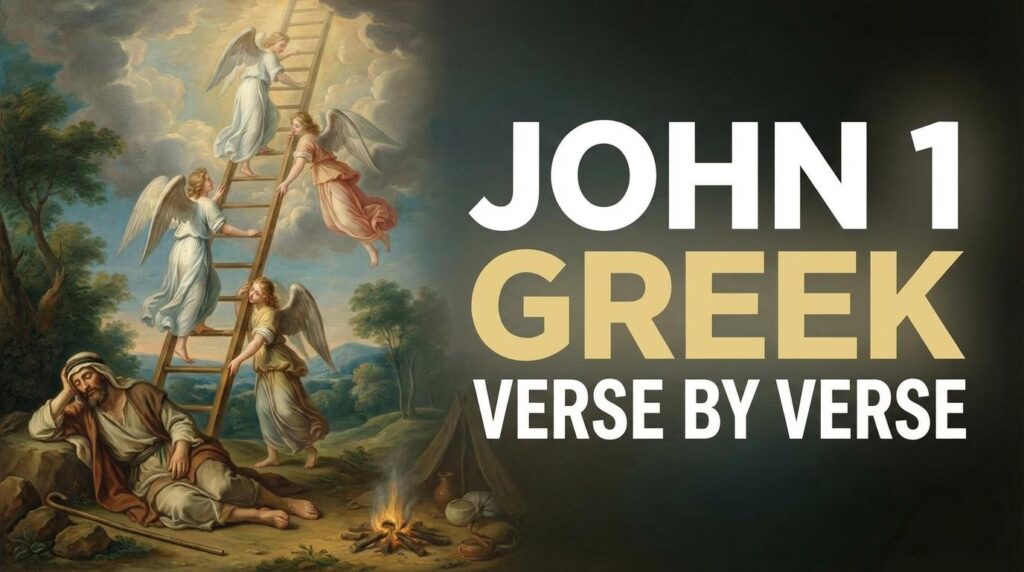
So you’re not a Jacob, you’re not a deceiver, you’re an Israelite, is what he’s saying implicitly. And then down here, does this sound like anything from the Old Testament? The angels of God going up and coming down on something? That’s the vision that Jacob had when he was sleeping one night and he saw the ladder.
This is Jacob’s Ladder. And we’ll look at the Old Testament passage, but the angels were going up and down on that ladder. So let’s jump there. Now I have it here. So this is Genesis 28: 12 in the Septuagint. The Septuagint is the ancient translation of [01:13:00] the Old Testament from Hebrew into Greek. The interesting thing about the Septuagint is that it’s actually a much older set of manuscripts than the Masoretic text that is used to translate most of the Hebrew Bible.
So yeah, there’s a whole, there’s a whole controversy and story about this, but just suffice it to say that the Septuagint, the Greek translation of the Old Testament. Was used by many, many people in Jesus’ Day. Jesus quotes from it, other New Testament writers and speakers in the text quote from it a lot and it’s worth paying attention to.
There’s definitely places where it’s much more accurate than the Masoretic text. Just trying to explain that the Greek translation of the Old Testament is worth paying attention to. And what does it say in Genesis 12? The story is about Jacob and look, κλίμαξ. So a ladder standing on in, in the earth, on the earth and the head or the [01:14:00] top of the ladder was into the heavens, reached up into heaven and the angels of God going up and coming down went up and went down on it, referring to the latter. So that’s Jacob’s vision, right? Notice these words, ἀνέβαινον, κατέβαινον.
Now we go back to this section, ἀναβαίνοντας καὶ καταβαίνοντας and then again, ἀγγέλουσ τοῦ θεοῦ. So it’s the exact same language that Jesus is using as Genesis. The difference is instead of the ladder, now it’s on the son of man, that the angels are ascending and descending, stepping up and stepping down. Jesus is very specifically reminding Philip and anyone else who’s listening, like maybe the other disciples, maybe Andrew and Peter and or, yeah, Jesus is talking to Nathanael, but I think Andrew, [01:15:00] Peter and Philip are likely listening as well.
Maybe others too. So he’s very specifically reminding Nathanael of the story of Jacob who became Israel, and he’s making quite an interesting claim about himself here, that he is Jacob’s ladder, like the ladder that Jacob saw was an image of Christ upon which the angels of God ascend and descend in that vision. I just thought that was so cool.