
Links
https://www.hup.harvard.edu/series/loeb-classical-library
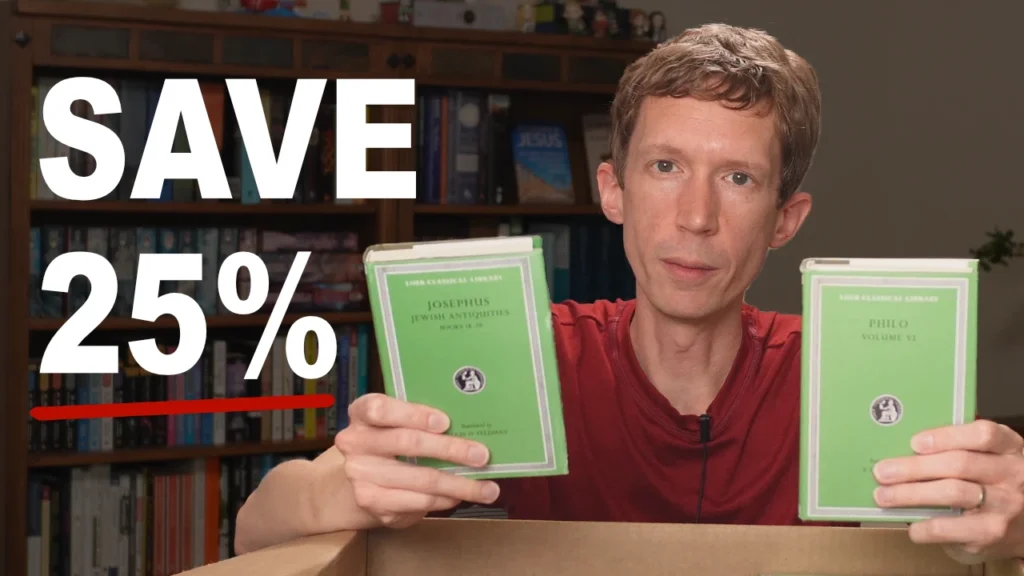
Use code EPICS to get 25% off (valid through July 31, 2026).
Full Transcript
I recently ordered 33 volumes of the Loeb Classical Library, and I ordered these direct from Harvard University Press. In this video, I’m gonna unbox those and then I’m also gonna discuss what the ordering experience was like going direct from the publisher versus ordering on [00:00:20] Amazon. After that I will discuss a couple of other questions. So one is why going with Loeb over the Oxford classical texts. So if you’re looking for books, classic books that have the original Greek, these are basically your two best options. So I’ll discuss why I went with [00:00:40] Loeb later in this video. Another question I will answer is why I got the books that I did.
So most of what this box contains should be Philo and Josephus. And if you’re learning the, to read the New Testament in Greek. So here’s the New [00:01:00] Testament. That’s the first thing you’re studying, right? But then the second thing is studying the Greek Old Testament. The third thing would be Philo and Josephus.
So I’ll talk about why those are kind of the next level, um, of material that you want to read in order to improve your New [00:01:20] Testament Greek. I’ll talk about that later. Okay, so let’s open this box and see how it is.[00:01:40]
Okay. So what I can see immediately is. They have a packing list taped to the inside of the box right here. So that’s handy.
They’ve got it pretty securely packed [00:02:00] with this paper. Um, all these are gonna be green. Because green is the Greek texts. Red is red, is the, is the Latin. So they have Greek and Latin let me see if I can tilt this up. And you can see in [00:02:20] there a bunch of green books. I’m not gonna take them all out right now, but for example, here’s Josephus, Jewish Antiquities, um, books 14 through 15.
Josephus, the [00:02:40] Jewish War Books one through two. One and two. And then let’s see if we can find something of Philo. Looks like Josephus is mostly on the top. Okay, here’s uh, Philo volume six, which it doesn’t [00:03:00] say on the outside what that is, which is not very handy. So if I open it up, it tells you who the English translation is by.
Okay. So you have to go for the Philo volumes it looks like you have to go to the table of contents to find, okay, this is on [00:03:20] Abraham, on Joseph, Moses one and two, and then the appendices. So that’s, that’s not very handy. So you kind of need to know. If you’re wanting to read a certain thing in Philo, you need to map that to the Philo volume number that [00:03:40] Loeb is using.
Uh, Josephus is a little easier because the, if you’re reading Josephus, the standard references you’re gonna see are to, you know, the Jewish War, antiquities of the Jews, and then the book number and then the paragraph number. So just from. From the spine or from the front of [00:04:00] Josephus, you’re gonna be able to easily find what you’re looking for.
Okay, so how’s the experience of ordering direct from Harvard versus going through Amazon? So this is a volume of Plato, really the first volume, which talks about like Socrates trial. [00:04:20] So I ordered this through Amazon and I wasn’t really impressed by the, by it was new, just like these are new.
I was not impressed by the quality of the dust jacket, uh, but if you, because it had like some rips in the front and just kind of scuffed in general. But as I look at these also [00:04:40] new volumes from Harvard, they’re, the dust jackets are, if anything even worse than the one I bought from Amazon. Not a huge deal, i’m still gonna be able to read ’em just fine, but. There’s a lot of scuffing on the dust jackets. Um, [00:05:00] some of them are pretty bent up in places and, you know, I think just the way they’re all packed into this box would be fine. You know, for, for most books it would be fine, but for a dust jacket that’s kind of fragile, it’s probably gonna get some [00:05:20] damage.
So this one, the dust jacket is pretty bent up on the top. I don’t know if you can see that, but it’s definitely my sense of these Loeb classical texts that whether they’re in their own warehouse… this is distributed by WW Norton, I think out of Philadelphia. But whether it’s [00:05:40] out of their warehouse and you’re ordering direct from the publisher, or you’re getting it from Amazon, it’s probably something that’s set on a shelf somewhere for a long time and maybe been shuffled around a few times, you know, without anyone, anyone buying it.
I mean, here’s another big tear in this, Philo volume [00:06:00] nine. So I’m sure if I just take off the dust jackets and the volumes themselves are gonna be in decent shape, um, you know, that’s gonna be fine. And the, the interior of the book is, the interior of all these books look perfectly new. I just get the [00:06:20] sense that they’ve probably sat on shelves and been shuffled around for a while.
And so the dust jackets just, you know, don’t look even close to new at this point. So that’s, you know, when you’re ordering a new book and you’re paying full price, that’s a little bit frustrating. Um, but it is what it is, [00:06:40] right? Harvard and Oxford both have kind of a monopoly, and so there’s not, not much you can do.
I did get a discount on these ordering direct from Harvard in bulk, and they gave me 25% off. The funny thing is that the day after I ordered these, [00:07:00] so I had spent a week sort of going back and forth with the publisher, getting the list of titles, getting a quote from them that included, um, the discount as well as shipping and, and sales tax.
And then the day after I ordered it, I got an email from Harvard saying that Loeb [00:07:20] classical library is 25% off. So even if you’re just ordering one volume. You can just go in. Um, it’s with the code epics, so E-P-I-C-S, all capital letters.
If you go directly to Harvard’s website, which I’ll link in the description down below. [00:07:40] Um, right now until I think the July 31st, 2026, you can get any of the Loeb, classical volumes, Greek or Latin for 25% off. So you don’t have to go through the process that I did. And everyone there was nice, like it was fine.
The emails were okay. It’s just, it’s [00:08:00] not as easy as just going on the website and ordering, right, and just putting in your credit card info and then it’s done. You know, it just takes less than 10 minutes, right? If you do that. So right now it’d be a good time to order. You can get 25% off without needing to buy in bulk.
So now I want to turn, so I mentioned a little bit about [00:08:20] some of the quality issues with Harvard. Um, so let’s talk about Oxford Classical Texts and compare that. I ordered three volumes from Oxford directly. Um, they’re more expensive in general than the Loeb Classical Library. I think they were around $60 a [00:08:40] piece for Oxford. These are both Plato, kind of the first set of Plato’s dialogues. Uh, the difference is the Oxford Classical Text has about twice as much material as this, as this, uh, Loeb from Harvard.
The Loeb is giving you the English translation. Oxford is just giving [00:09:00] you the Greek and then it’s giving you, variations between different manuscripts in footnotes in Latin. So if you don’t know Latin, it’s a little hard to make sense of that. And the book introductions for Oxford Classical Texts are also in Latin.
So. You know, [00:09:20] you really need to know Latin in order to make full use of of Oxford. The printing, I actually like the readability of Loeb a little bit better, which honestly was my number one factor in choosing which of these to get. I think the, the Loeb [00:09:40] Greek text is a little bit more readable, even though it’s a smaller volume.
You know, look in the width and height, this is significantly smaller. It’s gonna take up more space on your bookshelf because it has the English when you normalize to the same amount of material inside, inside, it’s gonna take it more [00:10:00] space on your bookshelf. But I thought the, the Loeb was a little bit more readable for the Greek, um, just the way it was printed. The font size in both is fine, but I just thought, um, the Harvard looked a little bit better, and it varies from volume to volume.
Um, having the English is also [00:10:20] nice right now, since most of this stuff it takes me a lot of time to work through the Greek and having the English there, um, can be good just to check and make sure your comprehension is right or if you see a term, several terms in a row that you don’t know, you can flip over to the English and see the meaning of [00:10:40] that. And then, I don’t know any Latin at all, so I can actually read the book introductions in Harvard Loebs, which is in English, and the footnotes are in English. So those are both, you know, good points for, for the Loebs, they’re a little smaller and, and definitely lighter. So it’s [00:11:00] more readable if you’re, you know, just sitting in a chair or even laying back on, on the couch or in bed. You can hold it up with one hand pretty easily.
The quality of Loeb honestly seems a little bit better to me, as well as when you take off the dust jacket. The Oxford Dust jackets [00:11:20] are just really cheap, like just really cheap paper.
If you take it off, the book is fine Underneath. I mean, it’s just a normal hardback book, but I think the, the Loebs look a little bit better without the dust jacket over, over Oxford Classical Texts.
[00:11:40] Okay. Last thing. Why Philo and Josephus? So if you’re watching my channel, you’re probably interested in learning Koine Greek in order to read the New Testament in Greek, right? That’s my focus, uh, not so much on Classical or Attic Greek. And if you’re, if you’re reading the New Testament in [00:12:00] Greek, okay, so here’s a, here’s a Greek New Testament.
This is the first thing, right? This is the main thing you want to understand, but. If you just read this and nothing else in Greek, then basically all, you’re not really learning the Greek at all. All you’re doing is comparing it to English [00:12:20] translations you’ve already read and kind of memorizing the, the text and the meaning.
You’re not really reading it in the way that a native Greek speaker would read. So in order to read the New Testament in, in… with some degree of real, true fluency, not just [00:12:40] memorizing the Greek text, you’re all, you’re gonna need to read other material in Greek. And the next most obvious one is the Septuagint, right?
This would be the next level after the New Testament. So you’re reading the Old Testament in Greek, and we know this was the Bible of the early church, right? Most of the [00:13:00] people, they were Greek speakers. They did not know Aramaic or Hebrew.
They were Gentiles. You know, after the, after the first, obviously the day of Pentecost, around that time, they were mostly Jewish people in the church, right? I mean, almost a hundred percent of Christians were Jews at that point. But fast forward [00:13:20] a few decades later, and most Christians are gentiles, or maybe it’s roughly even, and then you go a few more decades and it’s way more Gentiles than than Jews. So the Septuagint is the Bible of the early church. It’s in Greek, and it’s also the, the version that’s quoted by New [00:13:40] Testament authors who are writing in Greek. They, even though they were Jews, this was kind of the bible that they, that they quoted from when they wrote the New Testament in Greek and they would cite the Old Testament.
It’s usually cited from the Septuagint and agrees with the Septuagint more than it agrees with the Hebrew text. [00:14:00] So if you wanna understand the New Testament in Greek, this is the next level. You read the Septuagint and you increase your vocabulary even further, and you start understanding a lot of those references that the New Testament writers made.
But beyond that, so what’s the, what’s the next step? [00:14:20] Well, the natural next step is Philo and Josephus. So let’s get a couple of examples here. So what is it about Philo and Josephus that makes them worth reading, if you want to understand the New Testament? Well, aside from just, obviously Josephus’s historical writings [00:14:40] are very relevant to interpreting, uh, prophecy in the New Testament and such.
But the important thing is that these two guys, they wrote a lot of Greek words and if you’re learning the language, you need to read a lot of Greek. And the more you can read, the more fluent you will be. So Philo and Josephus they wrote in [00:15:00] Greek, but they were both Jews, so they, they frequently reference the Old Testament and Jewish customs.
And in general, the sort of demographic profile of both of these guys is close to the New Testament writers. Because most of the New Testament writers were [00:15:20] also Jewish, and these, Phil and Josephus were both contemporaries of the New Testament writers, or at least close to it, you know, plus or minus 50 years, they’re gonna overlap with everybody.
So if you wanna understand the Greek of the New Testament, this is sort of the next layer. [00:15:40] You go to Philo and Josephus and keep reading, keep practicing in order to improve your Greek. And once you do that, then imagine you go back to the New Testament having read a ton of other Greek writers, and suddenly you’re reading the New Testament, not just in the [00:16:00] sense of like sort of memorizing it.
You’re starting to understand it in a more fluent way, uh, in the way that somebody who lived in the first century would’ve understood it.
Okay, so thanks for watching this video. Uh, like I said, until July 31st, these Loebs are on sale, 25% off. If you go directly to Harvard [00:16:20] University Publishing’s website and use the code Epics, E-P-I-C-S.